
Our History
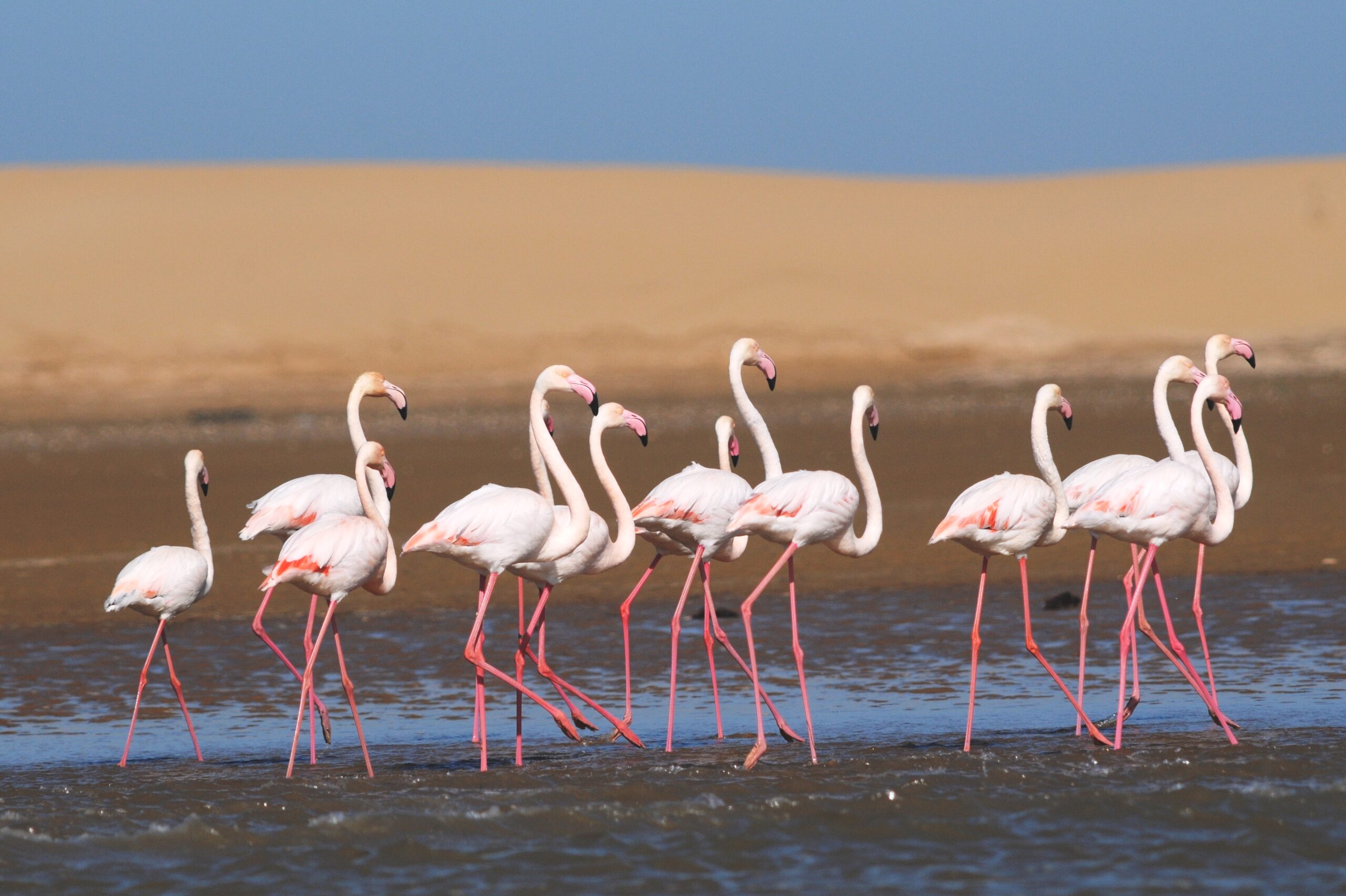
Photo by Maroc Radi Mohamed .
Who, What, & When
The Flamingo Specialist Group had its start as a world working group of the International Council for Bird Preservation in 1971. It was chaired by Roger Tory Peterson; Phil Kahl acted as secretary, and the membership included 13 people. The working group was reorganized in 1978 when it was decided that a subgroup to address Old World flamingos was needed. Alan Johnson was appointed Old World Coordinator and Alexander Sprunt New World Coordinator. The working group became a joint group of the International Council for Bird Preservation and the International Waterfowl Research Bureau. Bart de Boer was appointed New World coordinator by 1984. The name of the Flamingo Working Group was changed to the Flamingo Research Specialist Group in 1986 by request of the International Council for Bird Preservation.
The International Council for Bird Preservation became BirdLife International in 1993 and turned over all the responsibility for the waterbird working groups, by this time also associated with the IUCN Species Survival Commission (SSC), to the International Waterfowl Research Bureau. The International Waterfowl Research Bureau merged with the Asian Wetland Bureau and Wetlands for the Americas to become Wetlands International in 1995 and the Research Specialist Groups were renamed Specialist Groups. There was no New World coordinator for the FSG from 1995 until Felicity Arengo took this position in 2000, and Alan Johnson was generally recognized as coordinator of the FSG during that period.
Alan Johnson stepped down as Old World coordinator in 2004. Undoubtedly, the contributions Alan Johnson made during the more than 40 years that he studied flamingos while working for Tour du Valat and the 26 years that he led the FSG has influenced the FSG and flamingo research indelibly. The Tour du Valat research methods and collaborations resulted in an impressive understanding of the Mediterranean population of the greater flamingo, as recorded in the book The Greater Flamingo co-authored by Alan and Frank Cézilly and published by Poyser in 2007. The methodology employed at Tour du Valat served as a model for other flamingo monitoring and research endeavors, and Alan generously visited locations across the world to teach the catching, handling and banding techniques refined in France. He dedicated much effort to gathering information for the FSG publication and editing it throughout the years. It remains a valuable reference including much information not reported elsewhere. Alan received an FSG lifetime achievement award in 2014, shortly before his death.
The FSG leadership structure changed in 2004 when Brooks Childress was elected Chairman of the FSG. The Old and New World terminology was decommissioned: Felicity Arengo became coordinator for the Western Hemisphere and Arnaud Béchet coordinator for the Eastern Hemisphere. Nigel Jarret acted as assistant chair from 2005 until 2008. The home of the FSG moved from Tour du Valat to the Wildfowl and Wetlands Trust in Slimbridge, UK.
A re-structuring of the FSG steering committee was completed in 2023 when coordinator positions for five geographical regions and one global ex situ position were created and filled.
The Publication
Much of the below information can be found in the FSG’s periodic publication, the first of which appeared as the Old World Flamingo Working Group Newsletter in 1980. The name of the publication was tweaked a few times as the name of the group and the organizations overseeing it changed. It morphed into the Flamingo Bulletin in 2005, and in keeping with the times became eFlamingo when it went online in 2018. In total 22 issues appeared between 1980 and 2021. While its appearance has sometimes been sporadic this publication provides perspective and a wealth of information, much of which is still relevant.
It is possible to see through the publication how the scope of information included changed and expanded as the FSG network grew. When the fifth newsletter appeared in 1988, almost 200 copies were mailed to people, organizations and libraries in 35 countries. Costs were primarily covered by Tour du Valat, where Alan Johnson worked, and Alan was the sole or primary editor of the publication until he stepped down as coordinator in 2004. Perusal of the publication demonstrates how entrenched some of the problems that flamingos now face are: for example, there is mention in Newsletter Nr. 6 (1989) about the company Soda Ash Ltd. burying high tension cables between the feeding and breeding area in the Sua Pan, part of the Makgadikgadi Pan complex in Botswana, because it was known that the flamingos travel at night and would be at risk.
FSG Membership
The size of the FSG membership has varied greatly with time. It started with 13 people in 1971 and grew slowly to 35 members in 2003. A multi-year membership drive commenced in 2004, culminating in the highest number of members being recorded in 2010, with 304 members representing 215 organizations and agencies from 57 countries. Of these, 209 members were involved primarily with the conservation of flamingos in the wild (in situ), while 95 were involved primarily with flamingos in captivity (ex situ).
Membership is allocated per quadrennium, and in accordance with the wishes of the IUCN SSC governing body, membership is now being limited to people that will actively contribute to achieving the FSG objectives and goals. There were 54 members at the end of 2023, with a substantial number expected to join in 2024 & 2025 as potential memberships are reviewed.
[email protected]
International Symposia
The first international flamingo symposium was held 10-12 July 1973 at the Wildfowl Trust in Slimbridge, UK, and was attended by 62 participants from 14 countries. The symposium proceedings were published as the iconic book Flamingos in 1975 by Poser and were edited by Janet Kear and Nicole Duplaix- Hall.
The second international flamingo symposium took place 24-26 October 1998 in Miami, USA in conjunction with the annual Waterbird Society meeting, and 92 people from 22 countries participated. The proceedings were published in 2000 as the Waterbird Society Volume 23 Special Publication 1, Conservation Biology of Flamingos, edited by Guy Baldassare, Felicity Arengo and Keith Bildstein.
The third international flamingo symposium was hosted by Sea World San Diego 5-9 October 2014, with more than 100 participants from 18 countries present. Two side meetings were held, a Mediterranean working group meeting and a Lesser flamingo workshop. No proceedings were produced; however a book of presentation abstracts and a meeting summary report are available on the FSG website.
The fourth international flamingo symposium took place in November of 2025 and updates will be available on the FSG Events.
Keep an eye on our Events page for more news as we continue making history.